
Labor market
Minimum wage, maximum complexity: how the 2024 increase is landing in Songkhla's informal sector
The national policy announcement was clear. Its implementation in Hat Yai's informal economy is anything but — and three district labor-office datasets show exactly where the gap opens up.
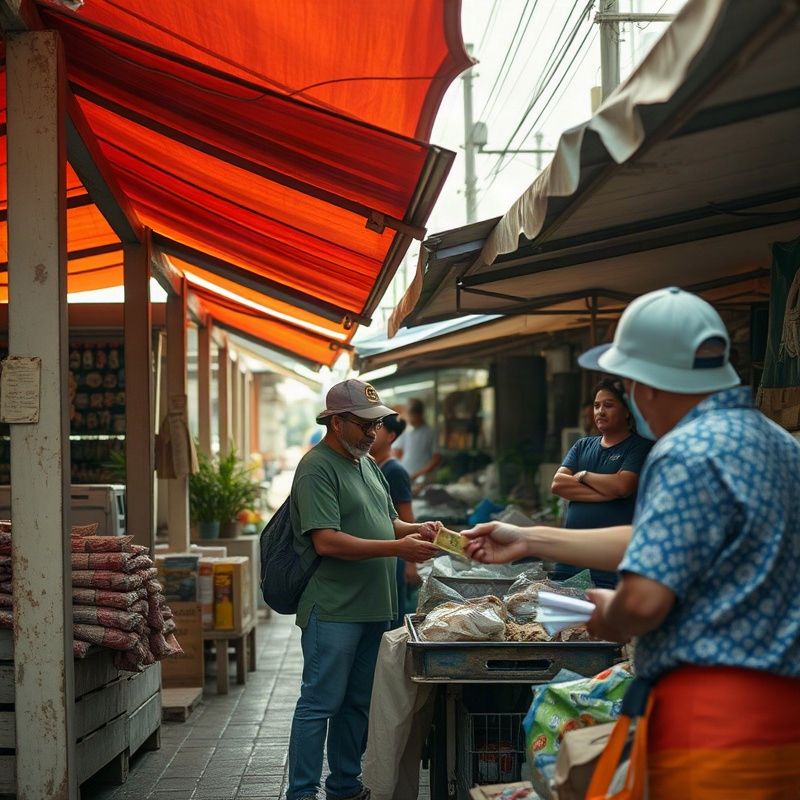
The policy and the reality it met
Thailand's minimum wage was raised to 400 baht per day in January 2024 in a uniform national adjustment — the most significant single increase in over a decade, framed by the government as a measure to cushion households against the cumulative cost-of-living pressures of the post-pandemic period. In the formal economy — companies with full social-security enrollment, proper payroll systems, and labor-inspection exposure — the adjustment has, by and large, been implemented. But in Songkhla province, as in much of the South, a substantial share of the workforce operates outside that framework. Market traders, construction day-laborers, domestic workers, and seasonal agricultural hands together account for an estimated 38 percent of the employed population in Hat Yai district, according to the National Statistical Office's 2023 informal-employment survey. For this group, the wage floor exists as a legal reference point but is enforced only intermittently. Payroll data from three district labor offices in Songkhla — obtained by Riverkalpha under a standard public-records request — shows that the average reported daily wage for informal-sector workers in the first quarter of 2024 was 362 baht: 9.5 percent below the legal minimum and barely 2 percent above the pre-adjustment rate of 354 baht. The increase, in other words, has largely not reached the workers it was most intended to protect.
Why enforcement is structurally difficult in Hat Yai
The enforcement gap is not primarily a story about employer bad faith — though that is a factor. It is a story about inspection capacity relative to the scale of the informal economy, and about the structural incentives that keep many workers from filing complaints even when they know the rate they are paid is below the legal floor. Songkhla province has 14 labor inspectors covering all formal and informal employment across the province's 16 districts. In Hat Yai district alone, the municipal economic registry lists over 4,200 registered market stalls and informal food vendors, a figure that excludes the entirely unregistered category. A single inspector conducting a standard compliance visit — documentation review, payroll sampling, worker interview — requires approximately three hours per establishment. The arithmetic of coverage is bleak. Beyond capacity, there is a deterrence asymmetry: informal workers who are migrants — and Songkhla's informal sector includes a significant population of workers from Myanmar — have structural reasons to avoid contact with government offices regardless of the issue. Labor-rights researchers at Prince of Songkla University, who have been tracking this population since 2020, estimate that fewer than 4 percent of migrant informal workers in Hat Yai district filed any kind of wage complaint in 2023. The minimum-wage increase was real policy. Its reach, in the part of the economy that needed it most, remains largely theoretical.